
MAHARASHTRA POLITICS: EVERYONE IS WITH EVERYONE — UNTIL THE SEAT IS DECIDED
In Maharashtra politics, alliances are permanent—until the ticket is announced. Then everything suddenly becomes negotiable.
The upcoming Legislative Council elections are giving us a fascinating snapshot of the politics behind the politics. Five seats are going to polls on October 23: three Graduates’ constituencies—Chhatrapati Sambhajinagar, Pune and Nagpur—and two Teachers’ constituencies—Amravati and Pune. On paper, Maharashtra has two major political formations: Mahayuti and MVA. On the ground, it is considerably more complicated.
Take Pune Teachers. The BJP has fielded Kaustubh Gawde. Its Mahayuti partner, Eknath Shinde’s Shiv Sena, has now fielded Mangesh Chivate against him. Congress’s Jayant Asgaonkar is also in the contest. So who is fighting whom? But I have heard, Chivte will take his form back, and if he doesn’t he can spring in a surprise. Have known since his journalism days, with excellent PR, strong backing in every form. BJP versus Shinde Sena. BJP versus Congress. And technically, Mahayuti versus Mahayuti. Chief Minister Devendra Fadnavis has acknowledged that consensus was not reached and that there is still time for discussions and withdrawals.
Then look at Pune Graduates. The BJP has fielded Smita Jadhav, while the NCP (SP) has Harshada Deshmukh. But this contest comes with another interesting political layer: Congress leader Satej Patil is Smita Jadhav’s uncle. Patil has publicly said that despite the family relationship, his political position remains with the MVA and that he will campaign for the MVA candidate. Family can share a surname. Politics doesn’t have to share a side.
Then comes Nagpur Graduates.
The BJP has fielded Sudhakar Kohale against Congress’s sitting MLC Abhijit Wanjari. But former BJP MLA Anil Sole has also filed his nomination, creating an internal challenge to the BJP’s official candidate. This is where elections become more than party-versus-party contests. They become party versus ambition.
In Amravati Teachers, Congress has fielded Aditi Pohare while Shiv Sena (UBT) has fielded Dattatray Lahane. Both are part of the MVA. Sanjay Raut has openly described such contests as “friendly fights”, saying his party intends to contest despite the alliance arrangements. Friendly fight? That may be the polite political phrase. But once the ballot paper arrives, every candidate wants the same thing. To win.
And then there is Chhatrapati Sambhajinagar Graduates. The Mahayuti formula had assigned this seat to NCP, while Shiv Sena (UBT) has fielded Dilip Ghuge. Within the MVA too, the Congress, NCP (SP) and Sena (UBT) had competing calculations over seat-sharing. Suddenly, the neat political map becomes messy. And perhaps that is the real story of Maharashtra politics today.
Alliances exist. But parties still exist. BJP wants to expand its space. Shiv Sena wants to protect its space. NCP wants its share. Congress wants to rebuild. Sena (UBT) wants relevance. NCP (SP) wants to remain politically significant. Everybody is together. Until everybody wants the same seat. This is not necessarily a sign that alliances are collapsing. Coalition politics has always involved negotiation, bargaining and adjustment. But Maharashtra has gone through extraordinary political realignments in recent years. Shiv Sena split. NCP split. Former rivals became partners. Former partners became opponents. And now the same political formations are sometimes fighting each other while remaining allies.
That is why the MLC elections matter beyond five seats. They offer a preview of the larger political question: How much space can allies give each other before cooperation becomes competition? The answer will not come from speeches. It will come from tickets, nominations, withdrawals, rebels and—finally—the ballot box.
Because OFF THE RECORD, Maharashtra politics can perhaps be reduced to four questions: Who gets the seat? Who gets the ticket? Who controls the organisation? And who is being quietly asked to adjust?
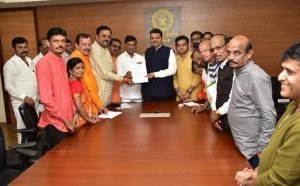
The press conferences will continue to speak about unity. The leaders will speak about coordination. The alliances will remain intact. But behind the closed doors, the negotiations will continue. Because in Maharashtra politics, everyone can stand together for the photograph. The real test begins when two allies want the same chair.
Vikrant Meena Hemant Joshi.