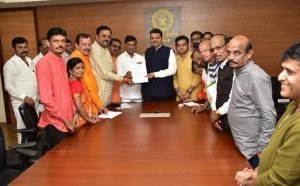

OFF THE RECORD: Is Satej (Bunty) Patil Building More Than a Fellowship?
An article in “Lokmat” (A Marathi Daily) by Yadu Joshi last Friday caught my attention: a report about Satej (Bunty) Patil’s fellowship initiative, which reportedly received 1,052 applications and selected 30 young fellows for the first phase. Before jumping to conclusions, let us understand what is actually being done. The initiative is built around the Yashwantrao Chavan Research Fellowship, an academic-looking programme aimed at giving young people an opportunity to study, research and understand Maharashtra’s society, politics and public issues, and how the government functions. And that is precisely what makes this interesting. Because the moment a political leader’s initiative enters an academic space in the name of ‘research’, the obvious question is NOT whether it is legal or legitimate. The question is about transparency, purpose and what happens after the fellowship ends.
Let’s begin with a question—not an allegation.
WHERE DOES ACADEMIA END AND POLITICS BEGIN?
If Satej (Bunty) Patil is not merely supporting an academic fellowship, but also consciously creating a network of young researchers and future political voices, is that really surprising? Politics has always understood the value of investing in the next generation. There is nothing inherently wrong with a political leader encouraging young people to research Maharashtra. In fact, politics needs more young people who understand issues beyond slogans, WhatsApp forwards and social-media battles.
Jayant Patil of the NCP has an impressive team of ‘researchers’ providing him with data, which is perhaps why the highest number of letters to the government questioning policies and decisions come from him. Devendra Fadnavis, too, has OSD Priya Khan, an academician who has helped him with ‘data’—and, if I’m not mistaken, even Vinod Tawde has sought her help in the past.
So, there’s nothing wrong with it. By the way, if Yadu Joshi could find out who exactly is retired Vidhan Bhavan Under Secretary Sanap, and what is his role in all of this? Also is this about making the initiative more informative—and perhaps keeping the likes of Bhai Jagtap in check?
If the programme has a genuine ACADEMIC objective, excellent.
But then come the questions.
What happens to these 30 fellows after the fellowship?
What networks do they build?
What political exposure, if any, do they receive?
Will these 30 continue working together?
Will their research remain purely academic?
“Will their work remain politically neutral, or will an ideological alignment with Congress emerge over time?”
Or could some eventually become researchers, writers, policy advocates, campaign professionals or political commentators? None of these possibilities is wrong. But they are worth asking about.
WHY 30 MATTERS
Thirty people may appear insignificant in Maharashtra’s enormous political ecosystem. It isn’t. Thirty motivated youngsters, trained to research, question, analyse and communicate, can become thirty researchers, writers, policy thinkers, political observers or future political professionals. That is potentially a valuable network. And if a political leader is helping create such a network, it is perfectly legitimate to ask whether this could also become a long-term investment in political influence.
Again, that is a question—not a conclusion.
The 30 fellows themselves certainly should not be called a “political army”. But the article mentions that they ‘helped’ MLAs/MLCs during the recently concluded Monsoon Session. Whom and what did they help? That is perhaps the more interesting question. They may simply be ambitious young people who genuinely want to learn. That distinction is important.
BUT HERE IS THE BIGGER QUESTION
Suppose Congress—or, more precisely, a Congress leader like Satej (Bunty) Patil—has found a model that successfully attracts hundreds of young applicants and selects a smaller group for structured research.
Why should Congress have a monopoly on the idea?
Why can’t the BJP do it?
Why can’t Shiv Sena do it?
Why can’t MNS do it?
Why can’t Sharad Pawar’s NCP do it?
Why can’t other political parties create fellowships for young researchers to study Maharashtra’s economy, agriculture, urbanisation, social movements, governance, public policy and politics?
In fact, they should.
Imagine BJP creating a such fellowship (already there is CM fellowship program)
Imagine Shiv Sena creating one focused on urban Maharashtra, local government and infrastructure.
Imagine MNS creating one examining Marathi identity, employment, migration and the changing cultural landscape of Mumbai.
Imagine Sharad Pawar’s NCP creating one around agriculture, cooperatives, rural economics and Maharashtra’s farming communities.
Let them compete. Let the best ideas win. Let young people participate without being forced into party politics.
THE ONLY THING THAT MUST BE CLEAR
If political organisations are funding, sponsoring or facilitating such programmes, the political sponsorship should be transparently disclosed alongside the academic character of the programme. If any Sanstha is paying for this stipend of Rs 10,000/- per month, why and how? Say if a political leader is funding or facilitating the initiative, that too should be clear. If the fellowship is genuinely independent in its academic functioning, that independence should be equally clear. There is nothing embarrassing about political parties trying to build intellectual and research capacity. What is problematic is only when political and academic identities become blurred without sufficient transparency.
THE POLITICAL FUTURE IS CHANGING
The traditional political worker is no longer the only important political asset.
Modern politics requires researchers.
Data analysts.
Policy thinkers.
Social-media strategists.
Young communicators.
People who understand how narratives are created—and how public opinion changes. A political leader who identifies talented young people early and gives them exposure may therefore be thinking beyond the next election. Perhaps that is all this fellowship is. Perhaps it is simply an academic initiative inspired by the legacy of Yashwantrao Chavan. Or perhaps it could eventually become something larger. We simply don’t know yet. And that is exactly why asking questions is legitimate.
OFF THE RECORD
If Congress has found an interesting way of engaging young minds, BJP, Shiv Sena, MNS, NCP and others should not complain. They should copy it. Improve it. Compete with it. Give young Maharashtrians opportunities to research their state. Let them study politics without necessarily becoming politicians. Let parties compete not merely for votes, but for ideas, research and young talent. Because tomorrow’s political battles will not be fought only at rallies or inside party offices. They will also be fought through data, research, narratives, ideas and the ability to explain Maharashtra to a new generation.
So, is this just a fellowship?
Or could it be the beginning of a larger political ecosystem around Satej (Bunty) Patil?
OFF THE RECORD, that is the question worth asking.
Not because the answer is already known. But because in politics, sometimes the smartest move is to recognise what is being built before everyone else notices it.
Vikrant Meena Hemant Joshi.